How Self-Acceptance Builds Quiet Confidence
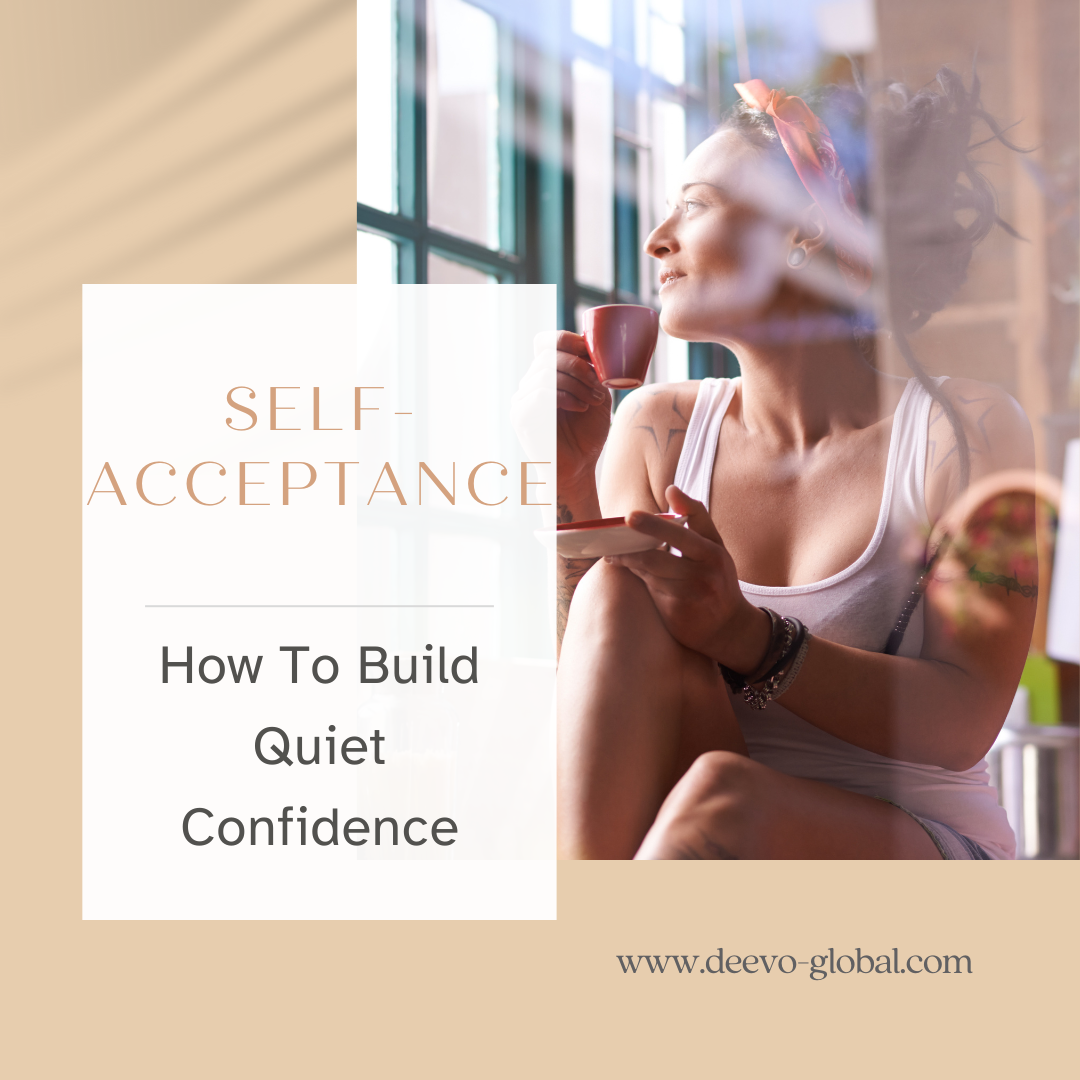

Many of us feel this deep need to be seen. Some more than others. We hide our real thoughts and emotions out of fear of being laughed at or not being accepted.
But accepted by who?
What are you afraid might happen if you stopped trying to be accepted?
It’s never really about them. It’s about you. And whether you’re willing to meet yourself where you are without needing an audience.
As children, we already learn that acceptance is tied to performance: good behavior, good grades, no mistakes. We earn the “good girl” or “good boy” label by doing well.
We simply want to fit in and get the validation that we’re doing good. We make a lot of noise by outperforming tasks, measuring ourselves against others, or collecting certificates to prove we’re worthy of being accepted. We become so busy convincing others that we forget the most important person: ourselves.
What would it feel like to no longer need acceptance from anyone outside yourself?
I dare to say that most of your belongings are measures of acceptance. They’re symbols of a status you’ve worked for so long.
When we feel unseen or uncertain about our value, we try to show it through things: careers, cars, clothes, followers, or lifestyle aesthetics. But instead of giving us identity, it creates dependency. The more we rely on what’s visible to define us, the less we hear the quiet voice of who we truly are. When roles or achievements fade, we feel lost because our worth was tied to doing, not being.
If all your hard-earned belongings were gone tomorrow, what would remain of your identity?
Self-acceptance isn’t something you decide once. It’s a daily practice, quietly nourishing your spirit. Like caring for a garden. You tend to it with love, remove weeds, and water it as needed.
The same goes for self-acceptance. Here are five simple ways to practice it every day:
Awareness → Seeing without judgment
Notice your thoughts, patterns, and emotions.
Don’t try to fix them, just witness them.
You’ll find that you can observe your thoughts without becoming them.
Distance is where acceptance begins.
Compassion → Softening the inner voice
Once you see yourself clearly, the next step is kindness.
Self-acceptance doesn’t grow in a harsh environment.
Replace criticism with curiosity: instead of asking “What’s wrong with me?” ask “What do I need right now?”
In that moment, you stop fighting yourself and start listening.
Integration → Welcoming all parts of you
Acceptance isn’t about liking everything.
It’s about allowing what is. You need uncertainty to see confidence, light to see shadow, and darkness to see the stars. Everything has its place; it’s all about balance.
You are only whole when you hold both: growth and imperfection.
Detachment → Releasing external validation
When you begin to accept yourself, the need for approval slowly loses its power.
And what happens when you no longer need validation? You become quiet. Because there’s no need to be loud.
That’s when your quiet confidence blooms.
Presence → Living from acceptance
The final step is practice. Every day.
Speak kindly to yourself
Allow rest without guilt
Be yourself, even when it’s uncomfortable
Choose meaning over perfection
Over time, this becomes your new rhythm. Simple, intentional, real.
What would ‘acceptance’ look like in your daily choices? Not as an idea, but as a practice?
We often confuse confidence with visibility. But real confidence has little to do with how loudly we show up. It’s about how gently we stand within ourselves.
This kind of confidence doesn’t compete, and it doesn’t convince.
It simply exists.
It allows space. For others, for silence, for imperfection.
It’s the kind of energy that doesn’t need attention to feel significant.
Confidence becomes quiet when it’s rooted in self-acceptance.
Because once you’ve made peace with yourself, there’s nothing left to prove.
What would your life feel like if confidence meant coming home to yourself, not performing for the world?


Kennst du dieses Gefühl? Du bist gut vorbereitet, kennst dich aus, indem was du tust und du hast eine Menge Erfahrung. Und trotzdem gibt es Momente, in denen du zweifelst. Wie kann das sein? Ich bin doch gut indem was ich tue? Das sind die Momente, in denen du bewusst oder unbewusst bemerkst, dass Selbstvertrauen…

I was so excited when I started, but a few days later I doubted myself and I asked “Who am I anyway?” These days exist. Unfortunately. But did you know, that those thoughts are solely to protect yourself? It’s your brain telling you that there is no evidence of success in the past. It’s better…

We spend so much time trying to find our purpose, as if it’s a hidden treasure somewhere outside of us. We read books, take courses, change jobs, hoping one day it will all make sense. But what if purpose isn’t something you find? What if it’s something that grows from within you, slowly and naturally,…
A gentle reflection on how real change begins. Real change begins quietly, in the moment you stop pretending you’re fine.
You know what’s good for others, like for your children, spouse, or friends. When they feel low, you support them with your knowledge and love. Even though you know it might be difficult for them, you push them gently.
And I think there’s a slight possibility you’re not doing the same for yourself. Actions of self-love, I mean.
We all know the symptoms of being in love with someone else. But what are the symptoms of being in love with ourselves? How do we know when it’s truly self-love? To be honest, I never thought about this until a few years ago. I didn’t even know it was important. But after I experienced…